
Dead People Deserve To Be Left Alone.
On Mining Every Bit of The Human Experience for Wellness Content.
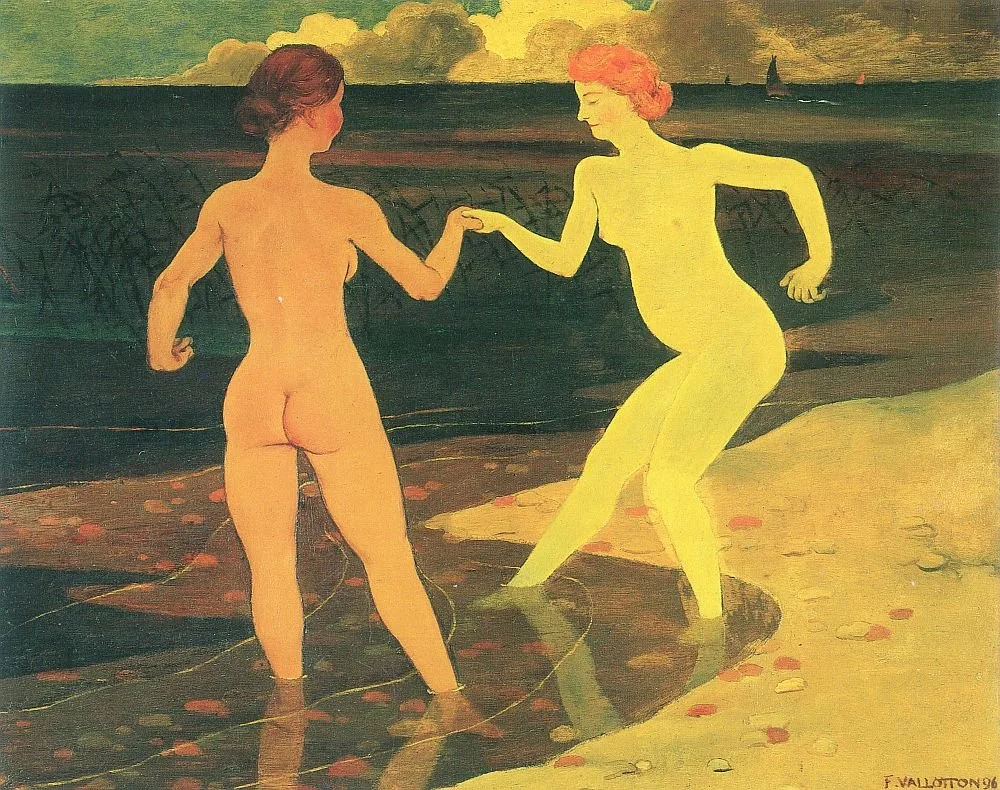
Félix Vallotton, The Mistress and the Servant, 1896, oil on cardboard
I remember the first time I lost all respect for a stranger on the internet because of how they exploited a recently dead person. This was in the late 2010s, and one of the staple teachers of the high-intensity yoga style community had recently died. Early, and fairly suddenly, from a public “not in the know” perspective.
A person who had a video of the recently deceased posted it on YouTube. I know better now, and I wouldn’t click on a video like that to save my life in 2026, but at that time, the video was framed as a truth-telling that countered what this teacher had said when they were alive. The first three minutes of the video were the interviewee (the recently deceased) saying “this is off the record” at least four times.
I remember thinking, “Wow, people should be allowed to just be dead”. Then I stopped watching and understood from that moment what kind of person would post a video like that online. Never again would their opinion hold any kind of weight with me, and in fact, I would know that in the case of the video post-er, they would do anything to get clicks, views, and clout. Nothing they said would be worth reading ever again, because like Marissa Mayer, I believe that how you do one thing is how you do anything.
Fast forward to 2026, and the idea of mining people’s deaths for content is not only standard practice, but reflects a larger trend in yoga and wellness–one where every moment of a person’s life cycle is fodder for content. Including death.
Transformation Station
The idea of showing people’s transformations as a sales strategy is a common one. It is seen in the before and after photos that personal trainers and gyms post to encourage people to stick with a routine, and it serves to show potential new customers that they, too, could transform into a fit, sports-bra-clad person who makes funny faces at the camera while flexing their muscles. It is one of the most commonly suggested strategies marketing coaches use for new clients.
Once we all started showing and talking about our personal transformations online, it seemed that no point in the cycle of our lives was off limits for the content mill. Did we birth a human, a dog, a plant, or a business? Of course, that goes online, with all the requisite celebrations–because those things are all the same, right?
Are we on a journey? Any journey? A journey where we push off responsibilities and travel around the world in our early 20s? A journey to the grocery store? A journey to find our “authentic self” while performing for the camera? A journey to the mailbox? All of that is content worthy.
Fail? Well, fail publicly for the content machine. Film yourself crying or make your failure aspirational by traveling to a beautiful (with filters) beach somewhere to film yourself being alone with your failure and your movement practice while wearing a tiny bikini. Everything is content.
And now, now we have even included death in this never-ending content cycle. Someone you don’t know and maybe only casually heard of or watched their famous television show in the 90s dies? Make sure you talk about it within 48 hours and tie it into your content. It doesn’t matter if you are selling hair products, yoga classes, or religious commentary. It all can be tied in.
Maybe you just “honor” them with a post. That seems like the relevant and respectful thing to do, right? But DM me “WELLNESS” for a link to my Substack on the 10 best nutrition hacks for a long and healthy life. Just like James/Lillias/Rev. Jesse/Catherine would have wanted.
FFS, just let people be dead.
FFS, just let people be dead.
We Lose The Plot When It’s All Content
There are moments when a person dies, or has long died, and a discussion of their death serves the greater community. In the yoga world, specifically, the discussion of guru-like teachers who have passed has served to uncover underlying predatory systems of abuse that had been lying under the radar of the general public for years.
This reckoning is a crucially important one, and one that gets deeply overshadowed when the discussion of these dead teachers is not only used to facilitate discussions about consent, sexual assault, and power dynamics; but also as another way to use shock marketing to sell online courses and coaching programs.
Here is a good framework when thinking about content that discusses the deceased. Is it functional? The discussion of the sexual abuse by revered teachers in the yoga space is an excellent example. Talking about the harm they caused and the environments they built and exploited truly helps to keep future practitioners safer. This is one way in which the discussion of the dead can serve us in the present.
The purpose of the discussion is not necessarily for any one person to gain clout or credibility, and the discussion on the whole–when done well–is not even really about the deceased person at all. It is about the system of abuse or harm that person created, and learning how not to replicate those patterns in the future. This is a point where we can learn from our failures and the failures of those who harmed and exploited people before their deaths. But again, the discussion is about the harm, not about the person. At some point, we all have to agree that they have done enough (be it good or bad), and it is time to stop talking about them.
The line gets drawn in the sand when we use the content of harm done by now-dead people to boost our own brand, service, or status in a community. I saw, recently, a social post using a disturbing video of a renowned yoga guru hitting a student publicly in class. That video was used as a catalyst for the post-er to bring clout to their message of selling yoga and marketing services to the people who follow him.
So while the video itself is worthy of examination as a reflection of how we can set systems in place within the industry to keep students out of the way of harmful hands during practice, it was not posted with that intention. As anyone who has studied communications and marketing knows (that’s me, by the way. Communication studies forever.), all content you post is marketing in some form or fashion. So the critique video of this dead master then lends credence to the person who posts it, showing that they are capable of saying the ‘difficult thing’ or having the hard conversations in public. That is known, in the marketing world, as building trust.
In true ironic fashion, with a choice that can only be made by two master shock-marketers when they use each other to gain traction and followers, another well-known yoga teacher made a video criticizing the first one as Orientalism gone awry. They then went on to say that the sexual abuse of minor children by priests in the Catholic church was talked about less culturally than the physical abuse perpetrated by yoga teachers. I hope you're rolling your eyes a little–that is an absurd and wholly inaccurate sentiment.
Perhaps my next article should be titled something like “My Sexual Abuse Survivor Story Isn’t Your Teachable Moment Online”. I am, like those children, also a sexual abuse survivor, and it is no less damaging to myself and folks like me when we use sexual assault (especially that of children) to validate an unrelated argument you make in your social media post. Because remember, everything you post online is straight-out marketing. God forbid any of us ever get in the way of a “shock-off” between two skilled marketers trying to sell their training courses. Not one of us would make it out alive.
And lord knows we aren’t allowed to just be dead.
The Dead and Unconscious Can’t Give Consent.
The reason why this tendency for people to use the deaths of others as part of their online marketing commentary is that it is the least risky path for the content creator. The subject of their praise, critique, or clout-seeking is unable to consent to the content and subsequently unable to fight back against the narrative created about them.
A recently deceased movie star couldn’t fight back against the cultural narrative that they were dismissive of their staff, and a long-dead yoga teacher cannot fight back against the idea that they were physically abusive by saying that colonialism makes that discussion incredibly complicated. The spiritual leader who died will be forever preserved in time as the best of us, and then whispered about as “he also hit his wife”. Dying solidifies the dead as having never really been one of us, we humans, and therefore, everything about who they were (or weren’t) is fair game.
If a person is going to leverage either the influence or the critique of another person, there is a real benefit to using a dead person for that job. The instant credibility someone receives by showing up as a “truth-teller” is worth the risk if the “truth” being told is about the dead. Living people have lawyers, assistants, and a different experience. Living people come with receipts. Living people can fight back and ruin the reputation of a random person posting online who is just trying to get someone to enter their 6-week challenge for the highest-tightest tush that ever walked down the street.
Living people posted those two videos I just referenced above. And they might have a different perspective on how or why they said what they said about a long-dead yoga teacher and childhood sexual assault victims. But don’t worry, my friends, my insurance is up-to-date, and unlike a dead yoga teacher, I can be reached for comment.
Online Popularity Demands Clarity. Beware, Nuance Follows.
So far in this article, I have done what I think is a passable job of making a straightforward argument about leaving dead people alone. They can’t consent to the discussion, and unless you are using it as a tool to benefit the living…it’s gross. Perhaps if you want the influence of being a person who says true but controversial things, you should update your insurance and talk about the people who are still alive.
But in yoga, the conversation is so much more complicated than that.
The line between 'I am shaped and influenced by this tradition' and 'let's go on retreat because I trained with this person' is very thin and worth taking a good, hard look at.
Any truly nuanced discussion of using proximity to deceased people in the yoga space has to include a discussion of lineage. And on this topic, I don’t have answers. In fact, I don’t think I am even super comfortable with the questions.
For a long time in the yoga space, because of the lack of a legitimate credentialing body, people have used participation in lineages to show honor to the deceased as well as to create credibility as teachers and practitioners.
Honoring lineage, which sounds like "I trained with X, I studied under Y," is one of the few legitimate uses of a deceased teacher's name and reputation. It is disclosure, it is context, and it is definitely how knowledge transmission works in contemplative traditions. But it shades into exploitation when said lineage claim becomes a credibility transfer primarily, when you invoke a dead teacher's name not to honor the tradition but to borrow their authority to sell your stuff. The line between "I am shaped and influenced by this tradition" and "let’s go on retreat because I trained with this person" is very thin and worth taking a good, hard look at.
Wellness Demands Our Lives on Show.
While I hate to bring everything back to the lack of infrastructure in the wellness profession’s working life, there is something to be said about this. True infrastructure, which looks like large-scale industry advocacy done by organizations that collect the clout and influence of people within said industry and use it to create guardrails and safety nets that protect us all, would create a working expectation that wellness in general and yoga specifically would learn how to see people as humans first and foremost. We would look at the human experience as something that is sacred, not as something to mine for content ideas while trying to sell a course on 15 Yoga Poses To Treat Menopausal Symptoms. With those guardrails, our lives could be ours again.
However, we are instead taught, often now by a young age, that everything we do is possible content for an online machine that chugs along without any care for us or our well-being. We use our struggles to be relatable, we use our wins to be aspirational, and we use the deaths of other people to raise our sphere of influence among our peers.
So the next time you are tempted to do the same, ask yourself these three clarifying questions.
Does this discussion serve people who are still being harmed by a pattern this person was part of? Or does it serve my platform?
Am I the right person to make this point, or am I just the person who thought of it first?
If alive, would this person recognize themselves in what I'm about to say, and would they feel used?
You may not know the person you are talking about after their death. Likely, you don’t. But if you did, and you had to face them at a dinner party the next week, would you consider cancelling and staying home to watch Derry Girls? That discomfort is something to sit with and ponder.
We have become, collectively, the Edible Woman — consumed continuously from birth to after death by a machine that was supposed to nourish us.
First, though, we need to agree as an industry (and culture) that the content machine has to stop somewhere. And if death isn’t where the content stops, there is something sacred that we lose. A bit of our humanity leaks out through the ducts of our eyes as we consume the lives of everyone from birth into eternity. And no amount of guardrails, legislation, or industry advocacy will ever save us from that–perhaps our saddest ending. We have become, collectively, the Edible Woman — consumed continuously from birth to after death by a machine that was supposed to nourish us.
So let’s just agree to leave dead people alone. Even vampires get more rest after death than we do.
Listening Suggestion: Here Comes Your Man by the Pixies.
Rebecca Sebastian has spent 25 years inside the wellness industry — as a studio owner, teacher trainer, yoga therapist, nonprofit co-founder, and media founder — which is exactly long enough to know where the snake oil gets bottled and where people go to find real, life-changing transformation. She is the host of Working in Yoga, a podcast with 160+ episodes, and the founder of Inside Yoga Magazine. Through the Real Hours Project, an ongoing data collection initiative, she has documented what it actually costs wellness professionals to deliver quality work — producing findings the industry has been reluctant to name out loud. She is currently writing her first book, a consumer protection guide to navigating the wellness industry without getting scammed, exploited, or talked into putting protein powder in your popcorn.