
An Editor’s Note: Issue 1
From The Editor:
Just yesterday, I realized something about myself: I am really excited about co-regulation—that is to say, I am highly attuned to shared nervous systems and relational environments.
Let me explain.
As I was assessing my comfort level across the projects I’m currently working on, I noticed that writing feels the most personal—and the most exposing—for me. I asked my friend Jivana, who is also a writer (and featured in this issue), whether he experienced this too. He said something that stuck with me: it’s harder to hide in writing than in many of the other kinds of work we do.
That sent me thinking about those other projects.
The roughly 18,000 hours I’ve spent teaching yoga classes (that’s not an exaggeration—I’m currently at about 18,142). The years of yoga therapy clients. The workshops, trainings, and events I’ve hosted. The 150+ podcast episodes.
All of that is relational work.
And it turns out, I really love relational work—work that doesn’t center only me, but how I am in relationship with other people in a room, whether virtual or in real life.
Which made me wonder: if we are this skilled at co-regulation, do we sometimes struggle to understand the value of our work precisely because it is so relational? Do we have a hard time separating the worth of our work from the feeling of connection it creates?
This might explain the collective angst around pricing.
I see you out there, wondering whether charging $100 instead of $140 will make or break a program. I see you stressing about whether your price excludes someone who is already under financial strain. I know how much this worries you.
When so much of our work is relational, it can be difficult to stand in a clear, individual relationship with our own labor—including our discomfort around money. It’s hard to say, “My work is worth $200 an hour,” when we’re used to that value being reflected back to us primarily through connection, appreciation, or shared experience.
At the same time, our capacity for co-regulation is not a weakness. It is one of yoga’s great collective strengths—one we have relied on implicitly for decades, often without building the structures needed to support it sustainably.
So how do we rebuild our industry—and construct career paths that actually allow us to earn enough to rest, take vacations, and stay in this work long-term?
I think we start by committing to a few things together this season.
First, we get clear about what it is we are actually selling. This point of sale matters.
Are we selling belonging?
Are we selling skills to down-regulate the nervous system?
Are we selling clarity, steadiness, or relief?
Clarifying what we are good at—and what we offer—is an essential clearing of the ground in any renovation or rebuilding process.
Then, we practice our non-relational skills. We practice standing in our own authority. We practice trusting the value of our work without needing immediate feedback from someone else to confirm it is okay to ask that price. And we do that repeatedly, until it starts to feel believable.
I know—this is vulnerable. Just like writing, there are fewer places to hide. Someone might judge your price (or my words), and you won’t be there to soften it or explain yourself in real time.
Still, I believe this is a leap worth taking, so let’s take it together.
We need new skills—individual and collective—that allow us to charge a living wage with confidence, grounded in the real value of what we offer. And then, once we’ve built that steadiness, we get to do what we do best.
We gather.
We co-regulate a bit.
And we build the future of yoga—together.
xx, R
This Issue Sounds Like…
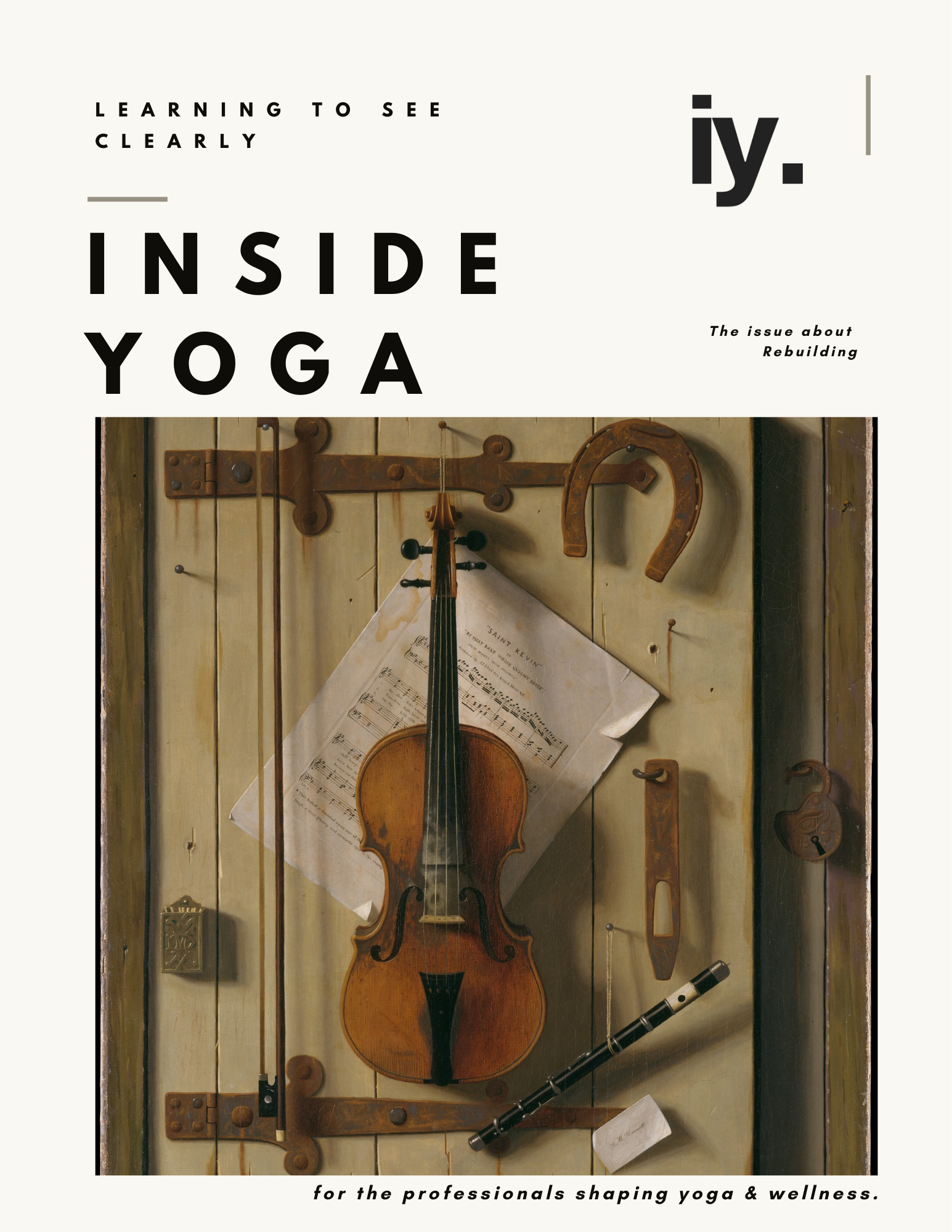
This one sounds like the moment after you've decided something — not the decision itself, but the stillness that follows. The grief of what you're leaving behind. The quiet of a room where something important just got said out loud. The particular kind of energy that builds when people who have been working alone for too long finally find each other in the same space.
This is the issue of rebuilding. Not the dramatic kind — not demolition and spectacle — but the ordinary, necessary, sometimes boring work of laying foundations that actually hold.
This is what that sounds like. -R
Cover Art: William Michael Harnett, Still Life-Violin and Music, 1888. Metropolitan Museum Open Access